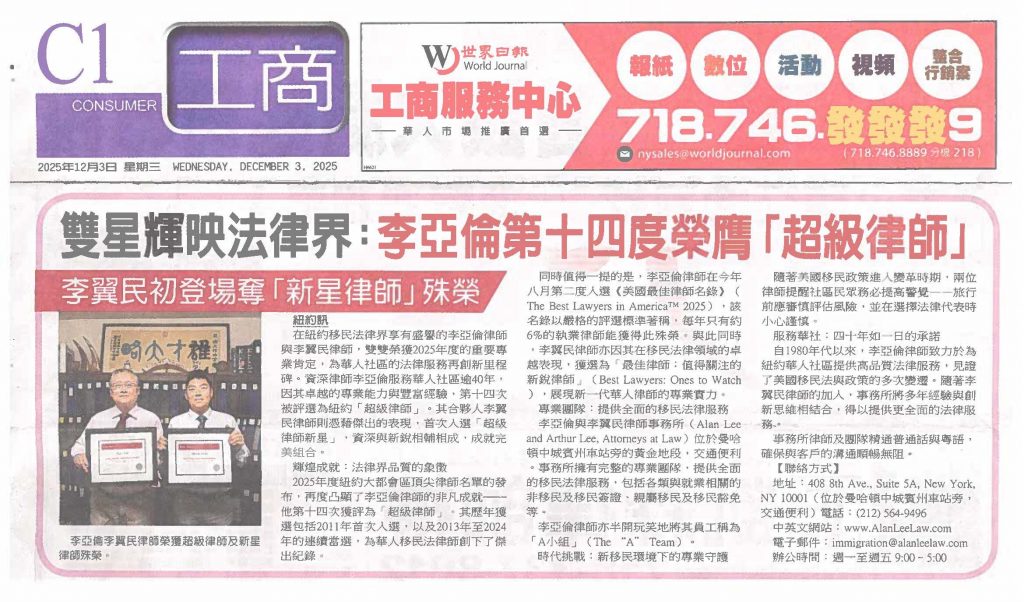
A Dual Star Shines in the Legal Community: Alan Lee Wins “Super Lawyer” for the 14th Time, While Arthur Lee Makes His Debut as a Rising Star

As published in the World Journal Daily on December 3, 2025


(New York) — Well-respected in New York’s immigration law field, Attorneys Alan Lee and Arthur Lee have both received major professional distinctions for 2025, marking a new milestone in legal services for the Chinese community. Veteran attorney Alan Lee, who has served the Chinese community for over 40 years, has been named a New York “Super Lawyer” for the 14th time for his exceptional expertise and extensive experience. His partner, Attorney Arthur Lee, has also been selected—based on his outstanding performance—for the “Super Lawyers Rising Star” honor for the first time, forming a perfect partnership of seasoned mastery and emerging talent.

Brilliant Achievements: A Mark of Quality in the Legal Field

The release of the 2025 list of top attorneys in the New York metropolitan area once again highlights the remarkable accomplishment of Attorney Alan Lee, who has been named a “Super Lawyer” for the 14th time. His recognitions include an initial selection in 2011 and consecutive selections from 2013 through 2024, setting a distinguished record for Chinese attorneys in the field of immigration law.

Also noteworthy, Attorney Alan Lee was selected for the second time this August for The Best Lawyers in America™ 2025, a publication known for its rigorous evaluation standards. Only about 6% of practicing attorneys earn this prestigious designation each year. At the same time, Attorney Arthur Lee was recognized for his excellence in immigration law as one of the Best Lawyers: Ones to Watch, showcasing the professional strength of a new generation of Chinese attorneys.

A Professional Team Providing Comprehensive Immigration Legal Services

Alan Lee and Arthur Lee, Attorneys at Law, is located in a prime area next to Penn Station in Midtown Manhattan, offering convenient access. The firm has a complete professional legal team providing comprehensive immigration services, including all types of employment -related nonimmigrant and immigrant visas, family-based immigration, and immigration waivers. Alan Lee not altogether kiddingly refers to the staff as the “A” Team.

Challenges of the Times: Professional Protection in a New Immigration Environment

As U.S. immigration policy enters a period of change, both attorneys urge community members to remain vigilant, carefully assess risks in traveling before taking a trip, and be careful in their choice of legal representation.

Serving the Chinese Community: Four Decades of Unwavering Commitment

Since the 1980s, Attorney Alan Lee has dedicated himself to providing high-quality legal services to the Chinese community in New York, witnessing numerous changes in U.S. immigration laws and policy. With the addition of Attorney Arthur Lee, the firm now combines extensive experience with innovative thinking, allowing it to deliver more comprehensive legal services.

The firm has fluency in Mandarin and Cantonese, ensuring smooth communication with clients.

【Contact Information

Address: 408 8th Ave., Suite 5A, New York, NY 10001
(Located next to Penn Station in Midtown Manhattan; very convenient transportation)
Phone: (212) 564-9496
Website: www.AlanLeeLaw.com
Email: immigration@alanleelaw.com
Hours: Monday–Friday 9:00–5:00

Alan Lee, Esq. Q&As published on the World Journal Weekly on November 23, 2025: 1. Encouraging organizations to begin PERM labor certification applications at latest when H-1B holders have finished the first three years

1. Encouraging organizations to begin PERM labor certification applications at latest when H-1B holders have finished the first three years

A reader asks:
I’m currently in my third year on an H-1B. My boss supports my green card application, but I’m a junior employee and haven’t been promoted yet. Our company’s policy is for managers to apply for JD Manager status. I’ve applied three times, but the immigration team rejected each application, saying it wouldn’t be approved. After some research, I think my situation is more like a YOE0, as I only have about a year of internship experience. What should I do? Should I consider changing jobs? Or should I talk to my boss again? Are there any other options? My current job is relatively stable, and my boss treats me very well. The only downside is the location. This is a rural area, and I’m feeling a bit depressed living here. I work as a model development analyst. I’m a bit unsure what to do.

Alan Lee Esq. answers:
As you are currently in your third year of H-1B, you would already have had two years of prior experience either within the company or outside. The manager can perhaps consider the company requirements for the position taking a harder look at your experience and other qualifications, or the company could perhaps consider you for a future position in which your current experience would be relevant. Your company appears to have a set procedure for beginning labor certification applications, which is commendable. You should continue to work with your manager as it does not appear hopeless at this time from the facts as you have given them. If you do decide to switch jobs, you may wish to confirm with a subsequent employer that it will start your PERM application soon since the process -from putting together job description and requirements, going through the prevailing wage determination, recruitment, and running time of labor certification applications – is currently very long. We ourselves are encouraging organizations to begin PERM labor certification applications at latest when H-1B holders have finished the first three years of the usual six-year period of time for H-1B’s, if not earlier.

ALAN LEE AND ARTHUR LEE HONORED WITH SELECTIONS AS TOP NYC LAWYERS IN IMMIGRATION LAW IN 2025

The 2025 annual list for the top attorneys in the New York Metro area is out and Alan Lee, Esq., was again selected as a Super Lawyer and his partner, Arthur Lee, Esq, selected as a Super Lawyer Rising Star. 

This is the 14th time that Alan Lee has been selected, having previously been honored in 2011, 2013-2024, and the first selection for Arthur Lee.

Alan Lee was earlier selected in August for the second time for the 2025 Best Lawyers in America™, which honors the top 6% of practicing attorneys in the country and Arthur Lee was selected at the same time as a Best Lawyers, Ones to Watch.

Both practice U.S. Immigration and Nationality Law in their law firm, Alan Lee and Arthur Lee, Attorneys at Law, near Penn Station in Midtown, Manhattan.

Alan Lee, Esq. Q&As published on the World Journal Weekly on November 16, 2025:1. EB-1A was approved, there are options for your spouse to maintain legal status 2. For H-1B extension, you can return to the US during the time that the extension is pending or after it has been approved if you have a valid H-1B visa

1. EB-1A was approved; there are options for your spouse to maintain legal status

A reader asks:
My EB-1 has been approved, and I plan to file my I-485 next month. I have a NIW visa cutoff for December 2022, so I can file. My wife just quit her job a few days ago. I was thinking that since my I-140 was still a long way off, I’d switch from H-1B to H-4 and take a break, then look for another job after getting my Combo EAD. But then, my EB-1A was approved, and my wife has officially submitted her resignation to her employer, so she can’t continue working and maintain her H-1B status. However, since I have almost all the documents ready, there should be no problem filing the I-485 within the next two months. If my wife’s H-1B grace period is still in effect, does she need to first file an H-1B to H-4 conversion and then file an I-485?

Alan Lee Esq. answers:
There appear to be three situations for your wife. The question is which one she wants to take, and this may have to do with gambling on the experience of the USCIS adjudicating officer.
The one option that everyone understands is filing to change status from H-1B to H-4 since a timely request to change status preserves nonimmigrant status. The second option to file the I-485s  within the 60 day grace period allowed for individuals on H-1B who leave or lose their positions. This requires more understanding from an immigration officer that the H-1B holder is legally in status during the 60 day grace period. The third option is to file outside the 60 day grace period relying on an immigration provision, §245K, which allows up to 180 days for a person not in status to still be able to file adjustment of status applications so long as the application is employment-based and the individual entered the US with a visa. This requires a little more understanding from an immigration officer.

2. For H-1B extension, you can return to the US during the time that the extension is pending or after it has been approved if you have a valid H-1B visa

A reader asks:
I’m a SWE2 at a Chinese company in H-1B status. I received notification this week that my I-140 has been approved. Over the past year, layoffs at various companies and the slow progress of my team’s projects have left me feeling extremely exhausted and often sleepless. I’m desperate for some rest. My family has been asking me to go back to visit my elderly family, so I’m considering returning to China. I’m thinking of taking this opportunity to return. I know that if I get my I-140 now, the green card wait time will be many years. Can I return to my home country now, then use my H-1B to find a job in the US in a few years, and then return? I can skip the lottery and apply for a new perm and I-140, ensuring my status is complete by the time the wait time comes. Is this feasible? Another question: My H-1B expires in September of this year, and my company has already applied for an extension, effective in September. How will this affect my return to my home country?

Alan Lee Esq answers,
Under your first scenario of going back to your home country and trying to come back to the US after a few years, you should be able to use the time that you have left under the H-1B to find a US job and return. You would avoid the visa lottery, and you may be able to have another company start up your PERM and I-140 processes picking up your priority date along the way. I assume that your concern about the H-1B extension goes to your other scenario of only returning to your home country for a short break and some travel with your parents and then coming back. For H-1B extension, you can return to the US during the time that the extension is pending or after it has been approved if you have a valid H-1B visa.

Article: EAD Automatic Extensions Abruptly Ended

As published in the Immigration Daily on November 4, 2025

On October 30, 2025, USCIS announced through an interim final rule (IFR) in the Federal Register that as of that date, it would no longer allow the 540 day automatic extension of employment authorization renewal applications for any applications filed on or after October 30, 2025. https://www.federalregister.gov/documents/2025/10/30/2025-19702/removal-of-the-automatic-extension-of-employment-authorization-documents   Applications filed prior to October 30, 2025, will continue to receive the benefits of automatic extension. To avert breaks in employment, the agency recommends that applicants file renewal applications up to 180 days prior to the expiration date. https://www.uscis.gov/newsroom/news-releases/dhs-ends-automatic-extension-of-employment-authorization. The rule affects those in the following classes who would normally be allowed the 540 days if they filed timely extension requests in the same employment authorization category:

  • Aliens admitted as refugees (A03);
  • Aliens granted asylum (A05);
  • Aliens admitted as parents or dependent children of aliens granted permanent residence under section 101(a)(27)(I) of the INA,8 U.S.C. 1101(a)(27)(I) (A07); 
  • Aliens admitted to the United States as citizens of the Federated States of Micronesia, the Republic of the Marshall Islands, or the Republic of Palau pursuant to agreements between the United States and the former trust territories (A08); 
  • Aliens granted withholding of deportation or removal (A10);
  • Aliens granted TPS, if the employment authorization category on their current EAD is either A12 or C19 (A12);
  • Alien spouses of E-1/2/3 nonimmigrants (Treaty Trader/Investor/Australian Specialty Worker) (A17);
  • Alien spouses of L-1 nonimmigrants (Intracompany Transferees) (A18);
  • Aliens who have filed applications for asylum and withholding of deportation or removal (C08);
  • Aliens who have filed applications for adjustment of status to lawful permanent resident under section 245 of the INA,8 U.S.C. 1255 (C09); 
  • Aliens who have filed applications for suspension of deportation under section 244 of the INA (as it existed prior to April 1, 1997), cancellation of removal pursuant to section 240A of the INA, or special rule cancellation of removal under section 309(f)(1) of the Illegal Immigration Reform and Immigrant Responsibility Act of 1996 (C10); 
  • Aliens who have filed applications for creation of record of lawful admission for permanent residence (C16);
  • Aliens who have filed applications for TPS and who have been deemed prima facie eligible for TPS under 8 CFR 244.10(a) and have received an EAD as a “temporary treatment benefit” under 8 CFR 244.10(e) and 12(c)(19) (C19);
  • Aliens who have filed legalization applications pursuant to section 210 of the INA,8 U.S.C. 1160 (C20);
  • Aliens who have filed legalization applications pursuant to section 245A of the INA,8 U.S.C. 1255a (C22); 
  • Aliens who have filed applications for adjustment of status pursuant to section 1104 of the Legal Immigration Family Equity Act (C24);
  • Certain alien spouses (H-4) of H-1B nonimmigrants with an unexpired Form I-94 showing H-4 nonimmigrant status (C26); and
  • Aliens who are the principal beneficiaries or derivative children of approved Violence Against Women Act (VAWA) self-petitioners, under the employment authorization category “(c)(31)” in the form instructions to the EAD application (C31).

The immediacy of the rule is shocking and definitely disadvantages those applicants with little time left who have not yet filed for one reason or another, e.g. waiting to see if their I-485 adjustment of status filings will soon be closed out or scheduled for interview or considering change to another status. Now they will have to scramble to file their applications or risk a gap in ability to work. For others, they should file as close to the 180 day mark as possible and hope to receive an adjudication before their time runs out.

Interested persons can and should give comments to the IFR. For example, they may discuss other actions that USCIS could have taken to lessen stated concerns of public safety and national security such as paring back the automatically extended time to 180 days or even 120 days, especially in light of USCIS inconsistency in adjudicating EAD extensions on a timely basis within 180 days. As per USCIS projected processing times, EAD renewals for asylum applicants are currently running 6.5 months; and although there is no breakdown between initial and renewal applications, I-485 adjustment EADs are running 3.5 months at the National Benefit Center (NBC), but seven months at Service Center Operations (SCOPS), and “All Other Applications” are 5 months with NBC but 10.5 months with SCOPS. https://egov.uscis.gov/processing-times/. It should also be remembered that USCIS many times exceeds the projected processing times, and inquiries usually bring back less than helpful responses. DHS gave short shrift to the idea of returning the 180 day automatic extension period, saying that it suffered the same flaws as the 540 day automatic extension, but there is a huge difference between 540 days versus 180 or even 120 days, and acceptance of an alternative would balance the concerns of public safety and national security with the expectation of US employers and applicants to have uninterrupted work if timely requests for extension are made. Comments are due by December 1, 2025, identified by DHS Docket No. “USCIS-2025-0271”, through the Federal e-Rulemaking Portal: http://www.regulations.gov.


Alan Lee, Esq. Q&As published on the World Journal Weekly on November 2, 2025:1. In applying for the green card, you should disclose all nationalities. 2. You should obtain another position in the same or similar occupation prior to the adjudication of your I-485 application. 3. After activating the Combo EAD card, you would technically have no status if your I-485 application is denied.

1. In applying for the green card, you should disclose all nationalities.

A reader asks:
I previously worked in Canada for a US company for a year, then came to the US as a Chinese national on L-1 status. I later became a Canadian citizen (but would like to retain my Chinese identity). My company is applying for a green card for me, but I have a few questions:

  1. Do I need to fill out the citizenship form on the green card application? Do I need to add that I’m a Canadian citizen? My US visa is for my Chinese passport, and currently only states “China.”
  2. If I truthfully state that I hold both Chinese and Canadian passports, can I apply for a green card using my Canadian passport? However, I’m a Chinese national in the US with L-1 status. If I disclose my Canadian status, will my Chinese L-1 status still be valid in the US?
  3. I’m working and living in the US with an L-1 visa (Chinese passport), but need to use my Canadian passport when returning to Canada. What should I do about round-trip travel between the US and Canada? Do they use their Chinese passport for entry and exit in the US, and their Canadian passport for entry and exit in Canada? However, sometimes flights check for valid visas when picking up their tickets. If I don’t have a Canadian visa or green card, can I just show my Canadian passport? However, the Canadian passport is not the same Chinese passport I used to purchase the ticket.
  4. Can I travel from the US to other Canadian visa-free countries using my Canadian passport without a visa? That way, there would be no exit record from my Chinese passport in the US on my return trip. Is this possible?
  5. Can I use only my Chinese passport to travel back to China from the US in the future?

Alan Lee Esq. answers:
While not claiming to know any immigration laws other than the US, it is my understanding is that China does not allow dual citizenship. It would appear that your questions concern  attempting to dance between passport presentations to one country or another. In applying for the green card, you should disclose all nationalities. The green card application is tied to your meeting the requirements for the green card, not to your passport. Revealing your Canadian citizenship should not affect your L-1 status as the L-1 depends upon your continuing to meet requirements of L-1 eligibility. On your questions 3-5 concerning which passport to use for entry and exit or to go to visa free countries or China, I cannot claim to know the answers as I am not aware of the immigration rules of Canada, visa free countries, or China. I would venture guesses that for Canada and visa waiver countries, you can use the Canadian passport although you should carry both and for China, it only recognizes one passport. Perhaps other legal counsel dealing in international law could answer your questions with more certainty, or you could contact consulates or embassies of the countries to which you wish to travel. Good luck.

2. You should obtain another position in the same or similar occupation prior to the adjudication of your I-485 application.

A reader asks:
I was currently an EB-3 applicant last year, and a major company filed an I-485. I had my fingerprints taken in September 2023 and received my combo card in mid-2024. I’ve been waiting about 450 days for my green card. In October 2024, I changed jobs to a Chinese company and applied for an H-1B transfer. I’m still on H-1B status. However, the new company hasn’t filed an I-485j yet. Your attorney must file it when you have a green card interview; don’t file it if you don’t have one. A week ago, I was unfortunately laid off and am now in the H-1B grace period. I have a combo card, so I’m not worried about legal stay in the US, but I’m concerned about green card approval. Will the company that laid me off not file an I-485j for me affect my I-485 approval? It’s my understanding that if I haven’t found a job after 60 days, my combo card will automatically be used to maintain my US status. Does that mean I don’t have to worry about being unemployed after 60 days? I just need to make sure my next company files an I-485j for me during the green card interview.

Alan Lee Esq. answers:
As you have maintained status at all times and are now in the H-1B grace period, your status is still good to file for a further H-1B with another employer at this time or to continue employment on your combo card assuming that it is not expired or expiring. In your situation, you do not have to worry about the fact that your last employment did not file for job porting under I-485J. You should ensure, however, that you obtain another position in the same or similar occupation prior to the adjudication of your I-485 application. You should not depend upon waiting until you receive a notice of interview as USCIS may make a decision on your employment-based case without giving you an interview.

3. After activating the Combo EAD card, you would technically have no status if your I-485 application is denied.

A reader asks:
After activating the Combo EAD card and starting to use it for work, if my I-485 is later rejected, can I still switch back to H-1B? I know this question has been asked many times, but the answers seem to vary. How do I do this specifically?

Alan Lee Esq. answers:
If relying upon only the combo card, you would technically have no status if your I-485 application is denied. In order for you to obtain H-1B status again, you would have to leave the US after H-1B approval (prior to 180 days of unlawful presence after the denial) and reenter the country under H-1B status. H-1B is a dual intent visa, and so the fact that you have applied for the I485 previously should not factor into the question of admissibility. What may be considered are that the I-485 was denied and the reason(s) behind the denial.

Alan Lee, Esq. Q&As published on the World Journal Weekly on October 19, 2025:1. Where the job is lost during the I-485 process, USCIS allows job portability for a same or similar position 2. The company was sold, PERM will most likely have to be refiled 3. If your case is exceeding USCIS published processing times, you can check online 4. The NVC generally assigns the interview location to the consulate requested on the immigrant petition

1. Where the job is lost during the I-485 process, USCIS allows job portability for a same or similar position

A reader asks:
I’m about to lose my job, but I have absolutely no motivation to look for another one. If I understand correctly, you still need a job similar to your previous one while your I-485 is pending. Do you need to be employed or at least have an offer and have submitted an I-485j when your green card is approved? Are there any location, salary, or start date requirements for the new job? How can I get a green card with minimal effort?

Alan Lee Esq. answers:
It is requisite for an applicant for I-485 through PERM sponsorship to have the job offer available from the sponsoring employer at the time that permanent residence is approved. The applicant should then continue to work for the sponsoring employer for some period of time after permanent residence is approved to show continued commitment to the job. Where the job is lost during the I-485 process, USCIS allows job portability where the applicant is able to locate a same or similar full-time position. This occurs where the I-140 petition has been approved and I-485 has been pending for at least 180 days. You should find a new opportunity prior to the adjudication of the I-485, not after. I cannot tell you how to do this with minimal effort. Location is not a concern for job portability although salary may be taken into consideration in judging whether the new position as in a same or similar occupation. The start date is best to begin before the I-485 adjudication, assuming that you have employment authorization to take up the position – otherwise at the time that the permanent residence is approved.

2. The company was sold, PERM will most likely have to be refiled

A reader asks:
My company’s office (a small division of the main company) is being sold, but I’m staying with the main company with the same role and job duties, although I will likely be fully remote since there will no longer be a physical worksite. My residence is in the same metropolitan statistical area (MSA) as the current office, and my PERM is still processing. Do I need to restart the PERM process under these circumstances?

Alan Lee Esq answers,
I believe that given the circumstances as you have presented them, the PERM will most likely have to be refiled. The rule of thumb is that a PERM application cannot be changed once it has been submitted. The first issue has to do with the sponsoring organization. If the employer as listed on the PERM application was the small company which is being sold and not the parent, there is an incongruity as to the sponsor that cannot be fixed unless the acquiring company adheres to and satisfies succession in interest rules. If the employer is listed on the application was the parent company, this problem could be avoided. The second issue would appear to be the worksite becoming fully remote. That in itself is a change of circumstance if the recruitment specifically designated a worksite. In that situation, the description of the job changes as the position would become more attractive to US workers and opens up the recruitment to anyone in other US states who may be interested in working from home even if the company itself is in a faraway state.

3. If your case is exceeding USCIS published processing times, you can check online

A reader asks:
I applied for EB-1A for more than half a year, and no one has contacted me. Could there be an issue with my application? I feel like my case was forgotten. Should I email the MDPI to ask why it is still pending and hasn’t even been denied?

Alan Lee Esq answers,
I assume by your question that you are complaining about not receiving a decision, as you would like to communicate with USCIS to ask why it is still pending and why you have not even received a rejection notice. That is because the processing time for EB-1A exceeds six months for the service centers adjudicating this category of cases. There are two – the Nebraska Service Center is taking 14 months to reach 80% of its filed EB-1A applications while the Texas Service Center is at 15 months. https://egov.uscis.gov/processing-times/

In the event that you believe in the future that the service center handling your case is exceeding USCIS published processing times, you can check the processing times through the above link, enter your case type and your USCIS office, and the website will inform you of the normal processing times for your type of application. You can also enter the date in which your application was filed at the bottom of the page. Once you enter that, the webpage will tell you whether your case is being processed normally or if it is outside normal processing times.
If it is outside normal processing times, then you may file an eRequest (https://egov.uscis.gov/e-request/Intro.do ) or chat with EMMA (https://www.uscis.gov/tools/meet-emma-our-virtual-assistant) to place a service request to inquire about the status of your case. You can also reach out telephonically to the USCIS Contact Center at 1-800-375-5283 to speak with a contact representative.

4. The NVC generally assigns the interview location to the consulate requested on the immigrant petition

A reader asks:
My talent visa application has been approved, and I now have temporary status in Hong Kong. At the same time, I applied for U.S. immigration. If my priority date becomes current, can I schedule a visa interview at the U.S. consulate in Hong Kong?

Alan Lee, Esq. answers:
The NVC generally assigns the interview location to the consulate requested on the immigrant petition, e.g. I-130 or I-140. If you obtain temporary permission to reside in Hong Kong, you should normally be allowed to have your interview in Hong Kong. You can request in writing to the NVC to have the site of your interview changed to Hong Kong with proof of your ability to remain in Hong Kong if Hong Kong is not already the designated consulate.

Article: A LOOK AT THE WEIGHTED SELECTION PROCESS FOR CAP H-1B VISAS

As published in the Immigration Daily on October 3, 2025

The Trump administration proposed by regulation a new method of selecting cap H-1B registrants for next year’s selection process in its September 24, 2025, “Weighted Selection Process for Registrants and Petitioners Seeking to File Cap-Subject H-1B Petitions.” https://www.federalregister.gov/documents/2025/09/24/2025-18473/weighted-selection-process-for-registrants-and-petitioners-seeking-to-file-cap-subject-h-1b.  Public comments are due by October 24, 2025. The gist of the rule is that selection will favor those organizations willing to pay selectees the highest wage level assuming that the H-1B cap is exceeded.

Prior to the Administration’s surprise Presidential Proclamation of September 19, 2025, placing an add-on fee of $100,000 for new H-1B petitions filed on or after September 21, 2025, https://www.whitehouse.gov/presidential-actions/2025/09/restriction-on-entry-of-certain-nonimmigrant-workers/,  there was no doubt that the cap would be exceeded. Now there may be a modicum of doubt since many organizations will be reluctant to post up $100,000 to bring in an applicant from overseas.

Assuming that expected legal challenges fail, the Proclamation’s $100,000 fee remains, and the number of registrants exceed the cap, the rules read like a real lottery under which organizations that pay the most have more chances to win – like lottery balls, you get four balls for level IV, three for level III, two for level II, and one for level I. If there are multiple organizations sponsoring an individual, the number of balls the registrant receives depends upon the lowest wage level of any of the registrations.

USCIS is wary that there may be some trickery such that some petitioners or their related entities filing a H-1B petition after having the applicant selected with the highest amount of balls and then transferring or amending a petition later by themselves or a “related entity” which would then reduce the wage to an amount in a lower wage level. Another possible trick mentioned would be to have a new or amended petition which includes the same proffered wage but changes the work location so that the proffered wage now corresponds to a lower wage level in the desired location. “Related entity” is being read expansively in the proposed rule to include a parent company, subsidiary, or affiliate company, but would not be limited only to those companies legally related to the petitioner through corporate ownership and control – that some factors relevant to relatedness may include familial ties, proximity of locations, leadership structure, employment history, similar work assignments, and substantially similar supporting documentation. USCIS would consider the totality of the circumstances.

Situations that might not necessarily raise the ire of USCIS and be found permissible could be work location changes between the time of registration and the time of filing the petition, such as in the case of an employer with multiple offices putting the person at a different office at a wage that equals or exceeds the same equivalent wage level for the new location.

Procedurally, in filling out the selection information, organizations would have to select the box for the highest OEWS wage level for the registration and provide the appropriate SOC code and area of intended employment.

On the possibility that the H-1B quota may not be entirely filled next year, it should be remembered that Indians fill approximately 70% of the H-1B positions with most being selected from overseas. Organizations may not be willing to pay $100,000 each to bring them over. Additionally, the traditional selection process does not merely select 85,000 to fill the regular and Masters caps. USCIS in the past has selected over 120,000 as it anticipates that there will be many non-filings by organizations that do not follow through, denials, withdrawals, and rejections.


Alan Lee, Esq. Q&As published on the World Journal Weekly on August 31, 2025:1. Can I apply for an O-1 visa to start working in the U.S. if my EB-1A is approved

1. Can I apply for an O-1 visa to start working in the U.S. if my EB-1A is approved

A reader asks:
We are in the UK and applied for EB-1A, with mainland China as our country of birth. We heard the wait time might be up to 5 years, which is daunting.  If EB-1A is approved, is there any way to enter the US sooner without waiting for the priority date? Could I apply for an O-1 visa to start working in the U.S. and then wait for the priority date while in the United States? Would getting an EB-1A make the O-1 application easier?

Alan Lee Esq answers,
An O-1 is a possibility to enter the US to work first and then wait for the priority date to become current. Although the O-1 visa is not strictly dual intent (allowing both immigrant and nonimmigrant intents), it falls within a gray area in which we have seen many visas issued at the US consulates even though immigrant petitions have been filed or approved. Kindly note that although EB-1A can be done through self-sponsorship, the O-1 require some form of organization sponsorship. The rules appear to be loosely interpreted currently on organization sponsorship even when the alien essentially owns the company doing the sponsorship.

Alan Lee, Esq. Q&As published on the World Journal Weekly on August 24, 2025: 1. I am self-employed during my OPT period. Will this affect my I-485?

1. I am self-employed during my OPT period. Will this affect my I-485?

A reader asks:
Some articles mention that if one has fewer than 180 days of unauthorized work after the last U.S. entry, they can still adjust status under 245(k). But in my case, I was on OPT and self-employed, which led to unauthorized employment. I later left the country, and when applying for H-1B, I marked “No” on the DS-160 question about unauthorized work and did not list that experience. The H-1B got approved. Now, when I apply for EB-2, if I disclose the unauthorized employment, will this trigger a 212 fraud issue? Is the risk high? Am I basically out of options?

Alan Lee, Esq. answers:
The DS 160 form does not contain a question on unauthorized employment. It only has a question, “Have you ever been unlawfully present, overstayed the amount of time granted by an immigration official, or otherwise violated the terms of a U.S. visa?” Thus it does not appear that you made a specific misrepresentation to the question of unauthorized employment, especially if you doubted that your self-employment may have counted as unauthorized work at the time of making your visa application. Fraud or misrepresentation also requires an intentional misrepresentation of the truth. In this case, such is doubtful given that there is not a specific question on unauthorized employment on the DS-160 form. You are correct that §245K can forgive unauthorized work under 180 days, but has no impact on questions concerning fraud or misrepresentation. I doubt that the question of misrepresentation on your self-employment during OPT will be a deciding factor in your adjustment of status application.