Alan Lee, Esq. Q&As published on the World Journal Weekly on December 28, 2025: 1. If you have already applied for an immigrant visa petition, it may prove difficult for an American consulate or embassy to issue you the F-1 visa

1. If you have already applied for an immigrant visa petition, it may prove difficult for an American consulate or embassy to issue you the F-1 visa

A reader asks:
I’m currently working full-time in the US on an L-1 visa and haven’t received an H-1B lottery yet. I’m worried about being laid off, so I want to prepare early. Since my L-1 visa is tied to my employer, I’ll need a new status if I leave. I’m thinking of applying for an F-1 visa and continuing full-time work with a day-one CPT. However, I applied for a NIW visa in early July 2024 and am still awaiting a decision, expected in April or May 2025.

If I receive an I-140, can I still apply for an F-1 visa to obtain a day-one CPT? As I understand it, submitting a NIW visa indicates an intent to immigrate, which doesn’t seem to be permitted on an F-1 visa. However, some say this isn’t a big deal, as the F-1 visa is issued by the embassy and has nothing to do with USCIS. Even if the embassy sees my I-140 when reviewing my F-1 visa, the backlog is so far away that it’s unlikely I can file an I-485 while my F-1 visa is valid. Are there any other ways to work in the US? For example, changing status within the country (from L-1 to I-20). This way, although I can’t leave the country, I can still work.

Alan Lee Esq. answers:
If you are considering changing to F-1 and using Day 1CPT to continue working full time, please note that USCIS considers some institutions to be abusing the privilege of CPT, especially where Day 1 CPT is concerned. There is a chance that taking such without sufficient reasons for the school to issue it may be cause for later immigration problems. If you have already applied for an immigrant visa petition such as through NIW, it may prove difficult for an American consulate or embassy to issue you the F-1 visa as you may not meet the test of nonimmigrant intent. In our experience, we have had more success with changes of status through USCIS as that agency will usually give an opportunity to you to demonstrate your nonimmigrant intent if your case is flagged. You have touched on this in your last questions and come to the conclusion that you could not leave the country but could continue working – a reasonable assumption on the first but a presumption on the second as to whether you can continue working given the above caution on Day 1 CPT.
Alan Lee, Esq. Q&As published on the World Journal Weekly on December 21, 2025 1. It’s difficult to apply for adjustment of status if the employee is no longer affiliated with his former company. 2. To change the priority date on your I-140 petition, please contact the USCIS

1. It’s difficult to apply for adjustment of status if the employee is no longer affiliated with his former company.

A reader asks:
I currently have an approved I-140, which won’t be 180 days until February 2026. However, my current company (Company A) operates in an extremely toxic environment. I haven’t been home to see my parents in years, so I plan to resign from my current company and leave the country. 2026 will be my fifth year on the H-1B. I’d like to return to the US to find a job after the market eases. I have a question:

If I resign and leave the US before my sixth year on the H-1B, will I need to re-enter the lottery and obtain a new H-1B visa if I find a job upon returning to the US? If I find company B willing to sponsor me in the future, when the current application is in the queue, my I-140 from company A cannot be used to apply for an I-485. Can it be used to extend my current H-1B visa? There’s a theory that if I leave the US for more than a year, I need to re-draw the H-1B visa. Is this necessary? How is the grace period calculated for resignation? If I change to another status (F or B) in the meantime, does that immediately end my grace period?

Alan Lee Esq. answers:
After resignation, the grace period is 60 days to find another H-1B position and file a new petition, change status, or leave the country. Given the time would take to change status to F-1 or B, the grace period would have ended. If you leave the country before completing six years on the H-1B, you have the balance of time in the event that you find another employer to sponsor you. If the I-140 approval is not timely revoked by the employer and there was no basis to revoke by USCIS for fraud or misrepresentation or error, it can be used for a one-year extension when the priority date becomes current. However, you must file the I-485 adjustment of status application within the one-year period in which the priority date becomes current. If you fail to file within that year, you may become ineligible for further extensions unless you can show that the delay was due to circumstances beyond your control. In the situation that you have described, it appears that you are not eligible for adjustment of status as you are no longer with company A.

2. To change the priority date on your I-140 petition, please contact the USCIS

A reader asks:
My EB-1 application, filed this month, was unexpectedly approved. I was pleasantly surprised to find that the priority date didn’t link it to my NIW from three years ago. I heard I can call USCIS and have it linked. How do I do this? Otherwise, I’ll have to wait forever to file my I-485.

Alan Lee Esq answers,
I am not aware that USCIS has a service under which it will change the priority date of the I-140 approval if it was not initially requested in the I-140 petition. Given the seriousness of not being allowed to transfer over the old priority date and the impracticality of filing a new I-140 petition, you or your attorney would hopefully be able to contact USCIS through its contact center at 1-800-375-5283 and have a sympathetic officer and supervisor assist you with the situation.

Article: SUMMARY AND ANALYSIS OF THE NOVEMBER 6, 2025, STATE DEPARTMENT PUBLIC CHARGE CABLE

As published in the Immigration Daily on December 10, 2025

Although not officially released, the Department of State’s November 6, 2025, public charge cable, “Visas: Properly Implementing the INA 212 (a)(4) Public Charge Ineligibility,” has made its way out to the public.

The following is a summary of its contents which, as with other Trump administration directives, places a number of obstacles in the path of those intending to come to the US on nonimmigrant or immigrant visas.

  • The current DHS regulation on public charge is aimed at an alien” likely at any time to become primarily dependent on the government for subsistence, as demonstrated by either receipt of public cash assistance for income maintenance or long-term institutionalized care by government expense.” DOS is directing consular officers to aim at aliens “likely at any time to become a public charge” and conveniently eliminating the words “primarily dependent”.
  • DOS instructions are for consular officers to consider all aspects of the case and determine whether the applicant’s circumstances assessed in the totality suggest that he is more likely than not to become a public charge at any time. [The pronoun “he” is being used in this article as the cable employs the pronoun throughout the cable].
  • Factors for consular officers to focus on are age, health, family status, assets, resources and financial status, education and skills, and any current or past receipt of public cash assistance for income maintenance or long-term institutionalization at government expense.
  • Age – For an IV applicant who is nearing or past normal retirement age, what is the likelihood of securing a job in the US that will allow him to support himself and any dependents without the need for cash public assistance? If able to secure such a job, will he be able to work for enough time before retirement to accumulate savings or pension benefits sufficient to support himself and his dependents over his lifespan without the need to seek public cash assistance or long-term institutionalization at government expense? Will he be receiving retirement benefits from the home country while in the US?
  • Health – Consider medical conditions including but not limited to cardiovascular diseases, respiratory diseases, cancer, diabetes, metabolic diseases, neurological diseases and mental health conditions. Does such an applicant have adequate financial resources or insurance coverage for such costs over his entire expected stay in the US without seeking public cash assistance or long-term institutionalization? For any class B condition, CDC directs the panel physicians to remark on the likely degree of disability or the need for extensive medical care or institutionalization, and the consular officer must consider the conditions in the physician’s remarks. Where the physician failed to include remarks, officers are to refuse the application under INA 221 (g) and return the medical exam results of the panel physician so that he can include the remarks. For applicants who expect to rely on employer-provided health insurance, what is the likelihood of his getting a job that provides such a benefit and how does he plan to maintain such insurance after retirement? Also consider aspects of the applicant’s health that are not necessarily class B medical conditions but could lead to a public charge determination when assessed in the totality of circumstances such as obesity leading to other more serious conditions.
  • Family status – Do any of the dependent family members have disabilities, chronic medical conditions, or special needs and require care such that the applicant cannot maintain employment? Officers should consider whether any applicant’s assets, resources, and financial status will allow him and any dependents to withstand the likely trials of life without the need to resort at any point to public cash assistance or long time institutionalized care with examples that pertinent financial planning normally includes having some cash savings in case of interruption in income or significant unexpected expense or having appropriate insurance coverage – “What are the applicant’s plans to handle a medical emergency while in the United States (including during that two week trip to the Grand Canyon)?”
  • Education and skills – Consider English language proficiency – even entry-level or lower skilled jobs require the applicant to be able to serve clients in English, get direction from supervisors in English, and read English language product instructions and warning. Officers can assess the applicant’s English language proficiency by conducting the interview in English, and if the applicant does not at least have basic English proficiency, he should have a realistic plan to acquire it and to support himself and his dependents without using public cash assistance during that time. For aliens in low skilled but demanding jobs like caregiving or agriculture or hazardous ones like meat processing or construction, officers should assess the applicant’s age, health, and family status and whether he will be able to work for enough time before retirement or in the event of disabling injury to accumulate savings or pension benefits sufficient to support him and his dependents over his expected lifespan. For an applicant who plans to work in a professional field, officers should determine whether he has the necessary qualifications and credentials and ask for diplomas and professional certificates and as appropriate, verify them with the issuing institutions. For professions that are subject to state-level licensing requirements, officers should determine how he will support himself and his dependents without seeking cash assistance during the time necessary to obtain necessary qualifications and credentials.
  • Current or past receipt of public assistance – Current or past receipt of public cash assistance for income maintenance or the need for long-term institutionalization is an indication that the applicant is or has been unable to provide for himself and his dependents and could become a public charge in the future. Officers should take into account any past receipt of such benefits in any country considering the totality of the applicant’s circumstances. They should also consider current or past use of any form of public assistance, social welfare, or private charity either in the US or elsewhere intended to help low income people including but not limited to housing assistance, food assistance (including the use of private food banks), and medical assistance.
  • Affidavit of support – Officers are to determine if the applicant is likely at any time to become a public charge. In the first place, officers should determine whether the sponsor or joint sponsor meets the domiciled conditions. Officers should consider the credibility of the affiant and examine the nature of the relationship between the applicant and anyone involved in supporting him. They should also consider whether the sponsor or joint sponsor uses or has used any public assistance, including but not limited to public cash assistance. Use of such benefits by a sponsor could indicate that he is or has been unable to provide for himself fully, thus calling into question his ability to provide for the sponsored applicant.

It seems clear that the Department of State through this cable is preparing to crack down on “undesirables” – the tired, the poor, and the huddled masses yearning to breathe free. The new America is to be a land of the affluent and healthy. Fitness to work for a long time and making financial or insurance arrangements in the event of emergencies or accidental events is to be the standard. Lack of education or English language ability are negatives. Whether dependents are healthy will impact upon the public charge totality equation or whether all members of the family will immigrate. Asking about whether an applicant has ever taken any type of public assistance of any sort from any country and including from private charities and private food banks is wicked and designed to trip up an applicant’s ability to immigrate here. Indeed, many millions of Americans have taken or are taking public assistance and if intending to emigrate to another country, the application of such a standard would make them the “undesirables”. It should also be remembered that many other American relied on private food banks during the recent government shutdown and during bad economic times in past years.

On affidavits of support especially, readers should be aware that the old practices will not apply under the cable’s standard. The I-864 form and documents will be under heavy scrutiny for credibility. The cable invites intrusive quizzing by consular officers on the relationship of the cosponsor to the applicant to judge the credibility of the cosponsor fulfilling the support obligation, and scrutiny of the sponsor or cosponsor’s ever having taken public benefits in the past as a mark of future inability to support.

The focus on obesity being a precursor to “high blood pressure, Type II diabetes, breathing problems, such as asthma and sleep apnea; joint problems, such as osteoarthritis; gallstones and gallbladder disease; and mental illness, such as clinical depression and anxiety” is unwarranted as people’s eating habits are now more than ever subject to change, especially with current blockbuster medications such as Ozempic and Wegovy and other GLP-1 supplements.

And for what period of time? The cable proposes a forever standard in its language on IV applicants who are nearing or past normal retirement age (is 65 the standard when many people are now working through their 70s?); calling for the applicant’s ability to take care of dependent family members to withstand the “likely trials of life”; and the applicant being able to accumulate savings or pension benefits sufficient to support him and his dependents “over his expected lifespan.”  The Department of State seems to forget that immigrants are eligible for government means tested program assistance when they become US citizens – usually after three or five years.

Besides being short on logic, the cable all in all is mean-spirited, un-American, and should be withdrawn.

Alan Lee, Esq. Q&As published on the World Journal Weekly on December 14, 2025 1. Chinese J holders are no longer subject to a two-year foreign residence requirement 2. Would applying for CPT negatively impact the I-485 approval?

1. Chinese J holders are no longer subject to a two-year foreign residence requirement

A reader asks:
I am currently in China, and my I-140 application has been approved with IVP selected. So, can I apply for a J-1 visa to go to the United States for a postdoc in advance while waiting for the priority date? When my priority date becomes current, can I then adjust my status to I-485? The maximum validity period of the DS-2019 for J-1 is 5 years. If I apply for a J-1 waiver early, but my priority date has not yet become current when my J-1 expires, will I have to return to my home country to continue waiting?

Alan Lee, Esq. answers,
While you can apply for a J-1 visa, please note that it is discretionary on the part of the American consulate and that your having an approved I-140 petition may cause concern as to whether you have the requisite nonimmigrant intent. If you take this route, please ensure that you put down on the visa application that you have applied for an immigrant visa petition. Not doing so might lead to a finding of misrepresentation on your part. Whether you have to apply for a J waiver depends upon whether you are subject – as of this year, Chinese J holders are no longer subject to a two-year foreign residence requirement by virtue of the skills list. If your priority date has not yet become current by the expiration date of your J-1, you would have to return home or stay in the US under some other type of visa status.

2. Would applying for CPT negatively impact the I-485 approval?

A reader asks:
My F-1 husband filed an I-485 in March. I haven’t received the biometrics appointment yet, let alone the combo card. I have an internship starting in October. Can I apply for CPT for the internship? Would applying for CPT negatively impact the I-485 approval?

Alan Lee Esq. answers:
I do not see that applying for CPT which is basically a work request would negatively impact the I-485 approval so long as the job is integral to the degree and authorized on the new I-20. DSO authorized CPT is governed by SEVIS, not USCIS, and there does not appear to be a bar on CPT related to a pending adjustment case.

Alan Lee, Esq. Q&As published on the World Journal Weekly on December 7, 2025: 1. A change of nationality generally will not affect green card processing

1. A change of nationality generally will not affect green card processing

A reader asks:
I applied for an EB-1A visa and is in the process. Currently, my family is in Europe awaiting for the priority date. Our NVC documents have been completed. Originally, my plan was for my children and I to change our nationality to the country where we live in Europe after I get its green card. My husband has other considerations and is holding off on changing his nationality for now. I’m not sure if this will affect my US green card application.

I’ve heard that the US only recognizes dual citizenship if the final nationality is US. I’m not sure if there are any other similar regulations during the green card period. Given the current backlog, which could last for the next two to three years, I’m considering renewing my nationality during the waiting of priority date. If so, do I need to withdraw the processed documents, renew the DS-260, and then resubmit it? How long would this take? What potential problems might arise from this process?

Alan Lee Esq. answers:
Change of nationality generally will not affect green card processing, as the determination of priority dates goes by country of birth and not country of nationality. The US recognizes dual nationality from a number of countries, mainly on a reciprocal basis and that we are friendly with those countries. Change of nationality and passport are considered significant factors in consular processing, and the DS-260 should be updated. Updating should be a fairly quick process.

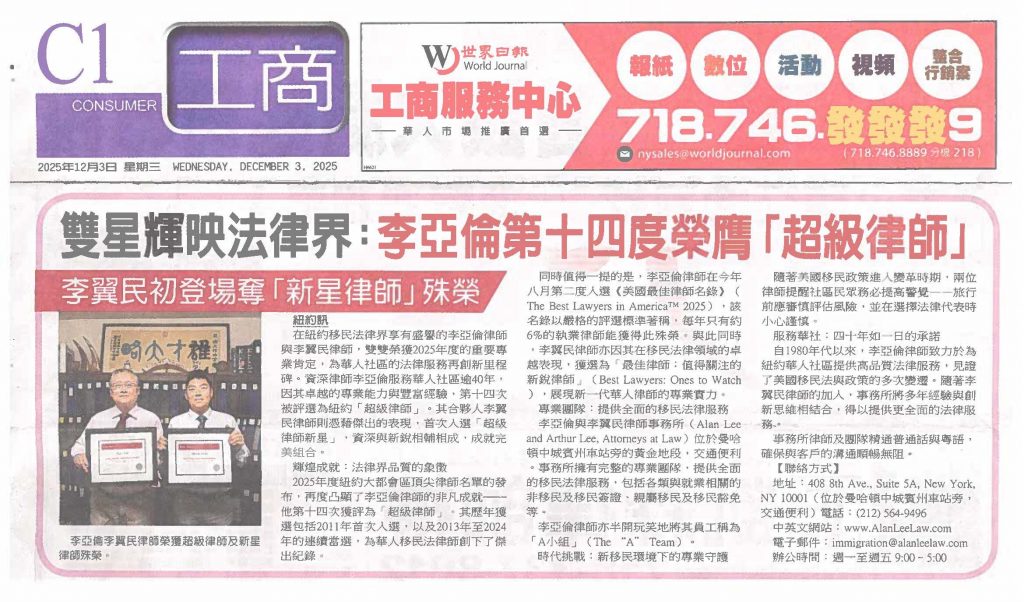
A Dual Star Shines in the Legal Community: Alan Lee Wins “Super Lawyer” for the 14th Time, While Arthur Lee Makes His Debut as a Rising Star

As published in the World Journal Daily on December 3, 2025


(New York) — Well-respected in New York’s immigration law field, Attorneys Alan Lee and Arthur Lee have both received major professional distinctions for 2025, marking a new milestone in legal services for the Chinese community. Veteran attorney Alan Lee, who has served the Chinese community for over 40 years, has been named a New York “Super Lawyer” for the 14th time for his exceptional expertise and extensive experience. His partner, Attorney Arthur Lee, has also been selected—based on his outstanding performance—for the “Super Lawyers Rising Star” honor for the first time, forming a perfect partnership of seasoned mastery and emerging talent.

Brilliant Achievements: A Mark of Quality in the Legal Field

The release of the 2025 list of top attorneys in the New York metropolitan area once again highlights the remarkable accomplishment of Attorney Alan Lee, who has been named a “Super Lawyer” for the 14th time. His recognitions include an initial selection in 2011 and consecutive selections from 2013 through 2024, setting a distinguished record for Chinese attorneys in the field of immigration law.

Also noteworthy, Attorney Alan Lee was selected for the second time this August for The Best Lawyers in America™ 2025, a publication known for its rigorous evaluation standards. Only about 6% of practicing attorneys earn this prestigious designation each year. At the same time, Attorney Arthur Lee was recognized for his excellence in immigration law as one of the Best Lawyers: Ones to Watch, showcasing the professional strength of a new generation of Chinese attorneys.

A Professional Team Providing Comprehensive Immigration Legal Services

Alan Lee and Arthur Lee, Attorneys at Law, is located in a prime area next to Penn Station in Midtown Manhattan, offering convenient access. The firm has a complete professional legal team providing comprehensive immigration services, including all types of employment -related nonimmigrant and immigrant visas, family-based immigration, and immigration waivers. Alan Lee not altogether kiddingly refers to the staff as the “A” Team.

Challenges of the Times: Professional Protection in a New Immigration Environment

As U.S. immigration policy enters a period of change, both attorneys urge community members to remain vigilant, carefully assess risks in traveling before taking a trip, and be careful in their choice of legal representation.

Serving the Chinese Community: Four Decades of Unwavering Commitment

Since the 1980s, Attorney Alan Lee has dedicated himself to providing high-quality legal services to the Chinese community in New York, witnessing numerous changes in U.S. immigration laws and policy. With the addition of Attorney Arthur Lee, the firm now combines extensive experience with innovative thinking, allowing it to deliver more comprehensive legal services.

The firm has fluency in Mandarin and Cantonese, ensuring smooth communication with clients.

【Contact Information

Address: 408 8th Ave., Suite 5A, New York, NY 10001
(Located next to Penn Station in Midtown Manhattan; very convenient transportation)
Phone: (212) 564-9496
Website: www.AlanLeeLaw.com
Email: immigration@alanleelaw.com
Hours: Monday–Friday 9:00–5:00